
"Usually" is carrying some weight in that sentence, though. For a practice that's already open, copywriting fees generally count as an ordinary and necessary business expense in the year you pay them. Three situations bend that answer, and they're the ones I see trip people up at tax time.
I'm Riley, a freelance copywriter in Spokane. For five-plus years I've written private practice healthcare copywriting for independent clinics that want to grow without sounding like a hospital brochure. I'm not a CPA, so I'll stick to what the IRS actually publishes and tell you where to double-check.
TL;DR Quick Answers
Private Practice Healthcare Copywriting
Private practice healthcare copywriting is marketing writing made for independent and solo practices: website pages, patient education articles, recall emails, and referral letters. For a practice that's already open, it's generally a deductible business expense in the year you pay for it.
What it does: brings in the right patients in the owner's own voice, instead of template copy any clinic could use.
Tax treatment: usually deducted as advertising, or as contract labor when a freelancer writes it.
Before opening: it counts as a start-up cost, with up to $5,000 deducted in year one and the rest spread over 180 months.
Freelancer paperwork: for 2026 payments, a writer paid $2,000 or more gets a Form 1099-NEC.
Smart move: ask for copy on its own invoice line, apart from design and development, so your CPA can classify it cleanly.
Top 5 Takeaways
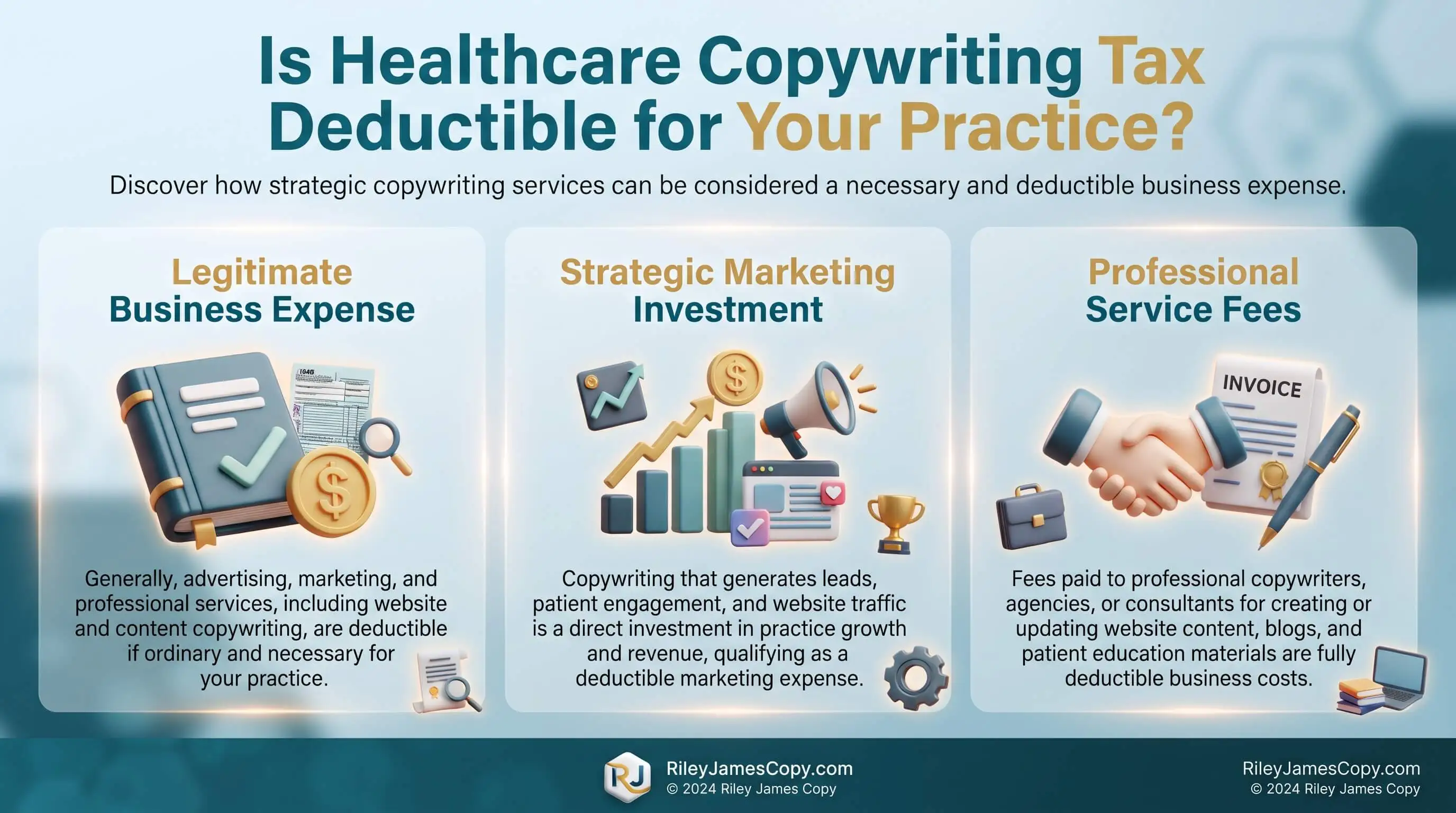
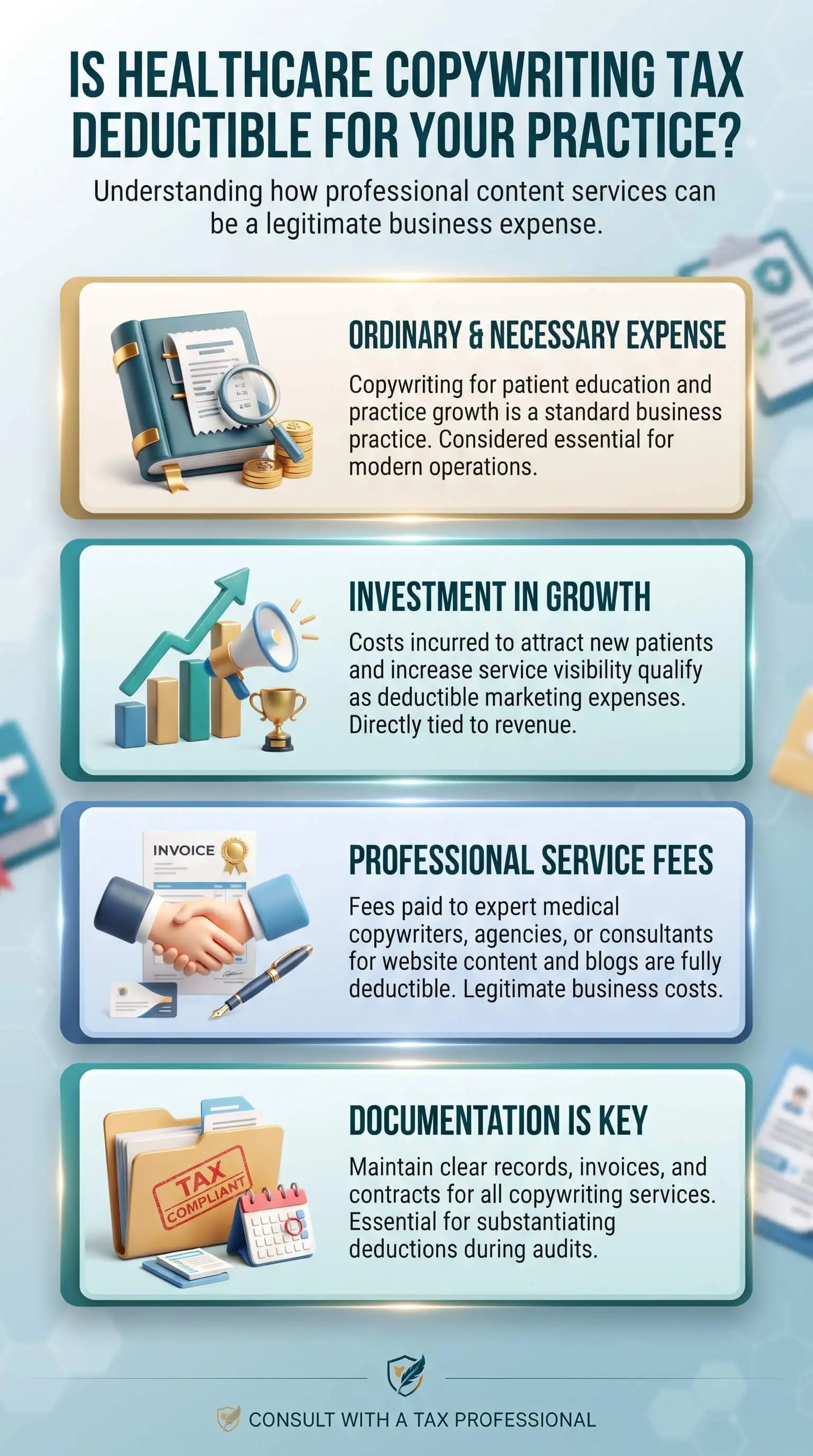
Most copywriting is deductible. For an open practice, it's generally an ordinary and necessary business expense in the year you pay it.
Pre-opening copy plays by start-up rules. Up to $5,000 in year one, phased out above $50,000, with the rest spread over 180 months.
Bundled website invoices muddy the water. Ask for copy on its own line, apart from design and development.
The 1099 line moved to $2,000. For 2026 payments, file Form 1099-NEC once an unincorporated writer crosses it.
Skip Publication 535. It's retired. Use Publications 334 and 583, then confirm the details with your CPA.
What Counts As Healthcare Copywriting For A Practice
In plain terms, copywriting is writing that asks a reader to act. For a clinic, that usually means picking up the phone or booking online. Here's what it covers in practice:
Service pages for the conditions you treat
Patient education articles, like plain-language guides to exudate types or what exudate color tells a clinician
Referral letters to podiatrists and primary care offices
Welcome and recall emails
Ad copy and brochures
All of it is marketing. That's the bucket the IRS treats as advertising, which is why most of this article is good news.
Why Most Copywriting Fees Are Deductible
The IRS test comes down to two words, ordinary and necessary. Ordinary means the expense is common in your field. Necessary means it's helpful and appropriate for your business, and IRS Publication 583 adds a line I like a lot: an expense doesn't have to be indispensable to count.
A wound care clinic paying for a page that explains debridement and offloading clears that bar without breaking a sweat. Clinics market themselves constantly, and a page that explains your care helps a worried patient pick you.
Two practical details:
Timing. Most small practices run on the cash method, so you deduct the fee in the year you pay it.
Where it lands. If you file Schedule C, your preparer will usually list copy under advertising, or under contract labor if you paid a freelancer. Partnerships and corporations use the matching lines on their own returns.
One warning about older advice. Plenty of blogs still cite IRS Publication 535 as the rulebook, but the IRS stopped revising it after the 2022 tax year. Publication 334 is the current guide for Schedule C filers.
Anything personal is out. A ghostwritten memoir about thirty years in wound care isn't a practice expense under medical healthcare copywriting services, however good the chapter on diabetic feet turns out.
Three Times The Answer Changes
Most articles stop at "it's advertising, deduct it." Here's where that advice falls short.
1. You Paid For Copy Before Opening Day
Copy you buy before the practice opens is a start-up cost. Publication 583 lists advertising right next to travel and training as a typical one.
Section 195 lets you elect to deduct up to $5,000 of start-up costs in the year the practice opens. That $5,000 drops dollar for dollar once total start-up costs pass $50,000, and whatever's left gets spread over 180 months.
Say you're opening a wound care clinic in April and paid for website copy in January. That copy probably lands in the start-up bucket. Tell your CPA the date the doors actually opened, because the whole calculation hangs on it.
2. Your Copy Is Buried In A Website Invoice
Here's the gray area. When a copy shows up as one line inside a big "new website" bill, it can get pulled in however your accountant treats the whole build. The IRS has never published one clean ruling on website costs, and the rules for development work have shifted more than once since 2022.
Ask for copywriting on its own invoice line, separate from design and development. That one request saves your CPA a lot of guessing.
3. You Paid A Freelance Writer $2,000 Or More
Here the deduction holds steady, and the paperwork is what changes. For payments made in 2026, you file Form 1099-NEC for any independent contractor you paid $2,000 or more for services. Through 2025, the line sat at $600.
A few details that matter:
Get a W-9 from your writer before you pay the first invoice.
If you paid by card or through a payment app, the processor generally files the report, so you don't.
Payments to corporations usually don't need a 1099-NEC.
Forms for 2026 payments are due February 1, 2027.
Records To Keep For Every Copywriting Invoice
The IRS doesn't require a particular system. Your records just have to show what you paid and that it was for the practice. For a copy project, I'd keep:
The signed scope or contract
An itemized invoice that splits copy from design and development
Proof of payment, whether that's a bank record, card statement, or check
The live URL or file you received
Your writer's W-9
File them with that year's return. Three years is the general window for most returns, and plenty of CPAs suggest holding on longer.
"Practice owners almost always ask 'can I write this off?' before they ask what the page will say. I get it. My answer hasn't changed in years. Ask your CPA, and make their job easy. That's why every invoice I send splits copy from design and development, because I've watched one vague 'website' line turn a simple deduction into weeks of back-and-forth with an accountant. Treat the deduction as a nice discount. The payoff comes from a page that sounds like you and gets the right patient to call."
Essential Resources
Seven worth reading before you file, or before you sign that copy quote. Every one comes straight from the IRS or the tax code. Skim the ones that fit where you are.
1. Start With The Current Small Business Tax Guide
If you file Schedule C, this is the IRS guide to keep open. Chapter 8 covers business expenses, and the 2026 notes include the new $2,000 reporting threshold.
Source: IRS Publication 334, Tax Guide for Small Business
2. Know Why Older Advice Is Out Of Date
The IRS stopped revising Publication 535 after tax year 2022. If an article still quotes it as current, double-check the rest of what it says too.
Source: IRS: Publication 535 Is No Longer Being Revised
3. Learn The Start-Up And Recordkeeping Rules
Publication 583 explains ordinary and necessary in plain words and lists advertising as a common start-up cost. Its recordkeeping section shows what the IRS expects you to hold on to.
Source: IRS Publication 583, Starting a Business and Keeping Records
4. See Where The Expense Lands On Your Return
The Schedule C instructions walk through each expense line, including contract labor for independent contractors.
Source: IRS Instructions for Schedule C (Form 1040)
5. Read The Start-Up Rule Word For Word
Section 195 is short. Read it once and the $5,000 limit with its $50,000 phaseout clicks into place, along with the 180-month spread for whatever's left.
Source: 26 U.S. Code § 195, Start-Up Expenditures (Cornell LII)
6. Grab The 1099-NEC Form
The IRS page for Form 1099-NEC puts the current form, its instructions, and any recent updates in one spot.
Source: IRS: About Form 1099-NEC, Nonemployee Compensation
7. Check The Filing Instructions Before January
The joint instructions for Forms 1099-MISC and 1099-NEC spell out who gets a form and when it's due, plus the exceptions where you don't have to file.
Source: IRS Instructions for Forms 1099-MISC and 1099-NEC
IRS publications, tax guides, and filing instructions help healthcare practice owners understand deductible copywriting expenses, start-up costs, recordkeeping requirements, and contractor reporting rules, while practical medical copywriting tips can help them make informed decisions when investing in professional website content.
Supporting Statistics
Three numbers worth knowing before you budget for a copy. Each comes from a different source than the resources above.
1. Most Patients Look You Up Online First
From July through December 2022, 58.5% of U.S. adults used the internet to look for health or medical information. That's the whole case for paying for a good copy. In my experience, the practice with the clearest answer is usually the one that gets the call.
Source: CDC/NCHS Data Brief No. 482: Health Information Technology Use Among Adults
2. The 1099 Line More Than Tripled
For payments made in 2026, the Form 1099-NEC threshold rose from $600 to $2,000 per contractor. January 31, 2027 lands on a Sunday, so forms for 2026 payments are due Monday, February 1.
Source: Paychex: Form 1099-NEC Filing Guide for SMBs
3. The Start-Up Deduction Disappears At $55,000
The $5,000 first-year start-up deduction shrinks dollar for dollar above $50,000 and hits zero at $55,000. A practice with $54,500 in start-up costs deducts just $500 up front and spreads the rest over 15 years.
Source: Congressional Research Service: The Small Business Start-Up Deduction
Final Thoughts And Opinion
Here's the honest version, from someone who'd rather lose a project than sell you one you don't need.
The tax question is the least interesting part of hiring a writer. For most open practices copywriting is deductible, which is good news because it lowers the price of doing the job right. Still, a deduction on a page nobody reads is money spent on a page nobody reads.
A few patterns I keep seeing:
Practices that ask for itemized invoices have an easy tax season.
Owners who launch a full website before opening day are often surprised their copy counts as a start-up cost.
Practices that buy the cheapest copy usually rewrite everything 18 months later anyway. Both rounds are deductible, and that still isn't a plan.
My take, plainly: treat private practice healthcare copywriting as an investment first and a write-off second. Get the words right and keep the paperwork clean. Your CPA can handle the rest.
Frequently Asked Questions
Q: Can A Medical Practice Deduct Copywriting As An Advertising Expense?
A: Usually, yes. Copy that markets your practice, from service pages to recall emails, is generally deductible in the year you pay for it.
Q: Is Patient Education Content Tax Deductible?
A: Generally, yes. Paying a writer for a plain-language guide to wound drainage informs patients and promotes your care. That's a normal business purpose.
Q: Can I Deduct Copywriting Costs Before My Practice Opens?
A: Yes, under the start-up rules. You can elect to deduct up to $5,000 in the year the practice opens and amortize the rest over 180 months. The $5,000 shrinks once total start-up costs pass $50,000.
Q: Do I Have To Send My Copywriter A 1099?
A: It depends on the amount and how you paid. For 2026 payments, file Form 1099-NEC for an unincorporated contractor you paid $2,000 or more. If you paid by card or payment app, the processor generally reports it instead.
Q: Is A New Practice Website Deductible In The Year I Pay For It?
A: Ongoing marketing copy usually is. A full website build can be treated differently, and those rules have shifted lately. Have your writer bill copy separately, then let your CPA classify the build.
Q: Does Private Practice Healthcare Copywriting Count As Advertising Or Professional Services?
A: Most preparers file it as advertising, or as contract labor when you pay a freelancer. The professional services line on Schedule C is meant for accountants and attorneys, so copy rarely goes there.
Let's Get Your Copy Working For Your Practice
Think of the write-off as a bonus. You're paying a freelance healthcare content writer for words that sound like the person patients learn to trust, not a template that sounds like everyone else. Book a free 15-minute call with Riley James Copy, and you'll leave with an itemized quote your CPA will appreciate and a straight answer on whether the project is worth your money.


